Scout
AI Matchmaker
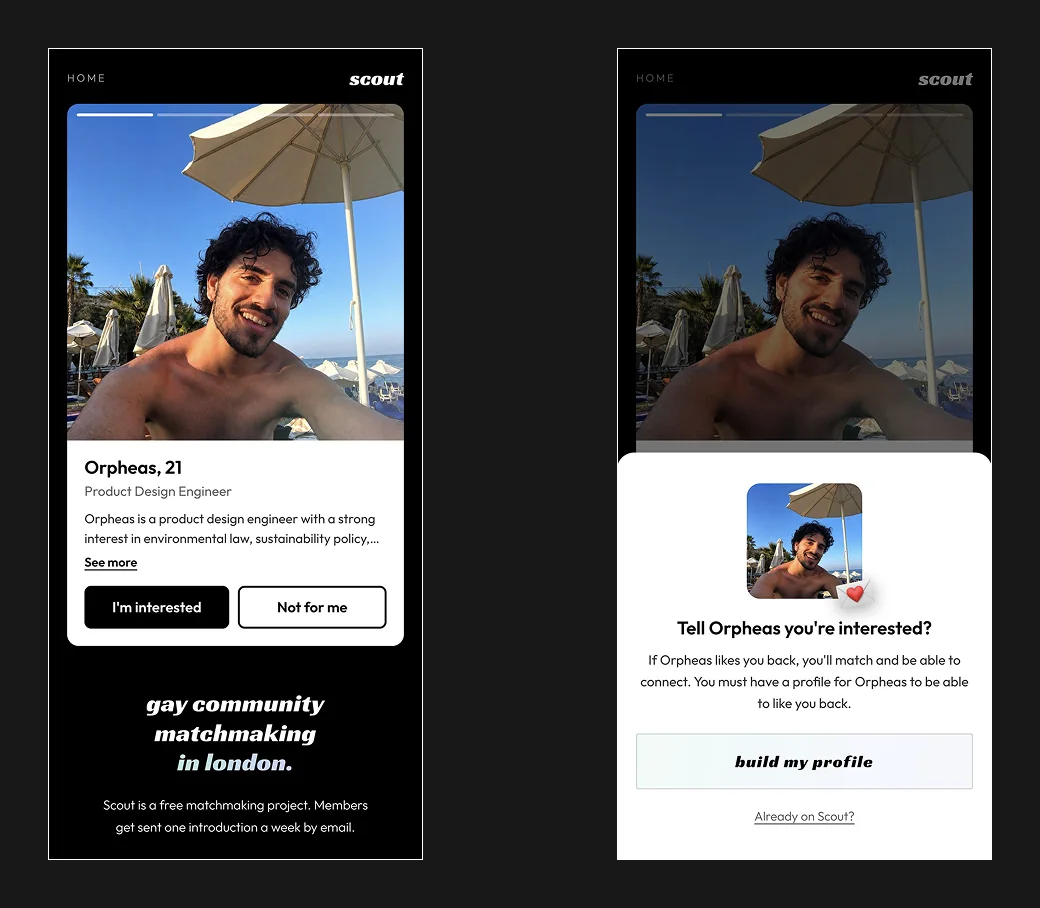
A matchmaking service, not a feed to browse
Problem: Dating apps hand you an endless feed and leave you to do all the work. The effort sits with the member, and the app has no opinion about who you should actually meet.
Solution: Scout works like a matchmaker. Members say who they are and what they want, and the system evaluates compatibility across the member base, ranks the strongest candidates, and emails a small number of personalised introductions explaining why the two of them might work.
I built it end to end as a solo founder: product strategy, UX and interface, the matching and ranking system, the AI behind every introduction, its evaluation harness, and growth.
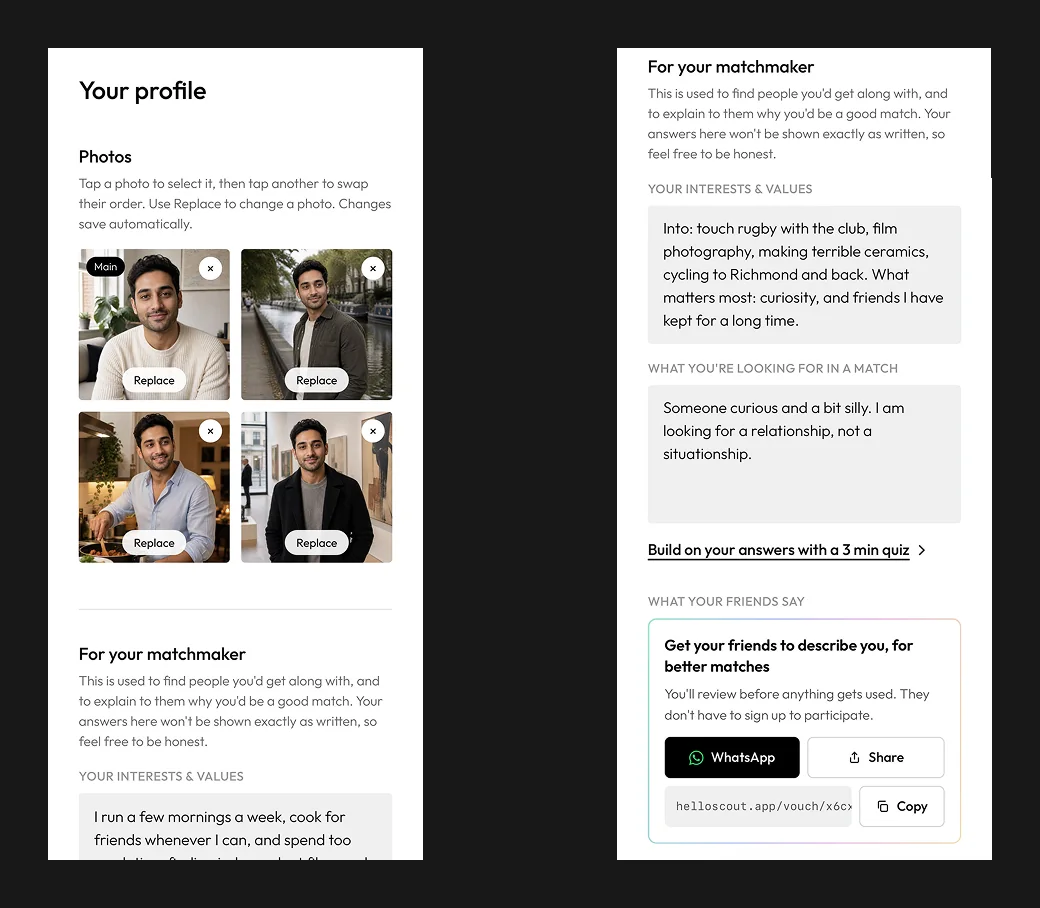
Profiles are written for the matchmaker, not for display
Rich inputs, not swipes
- Members write about themselves in their own words: their interests and values, and what they actually want from a relationship.
- A short quiz builds on those answers, and friends can add their own description of a member — signal people rarely write about themselves.
- None of it is shown verbatim. It exists so the system has enough to make a real compatibility judgement instead of ranking on photos and filters.
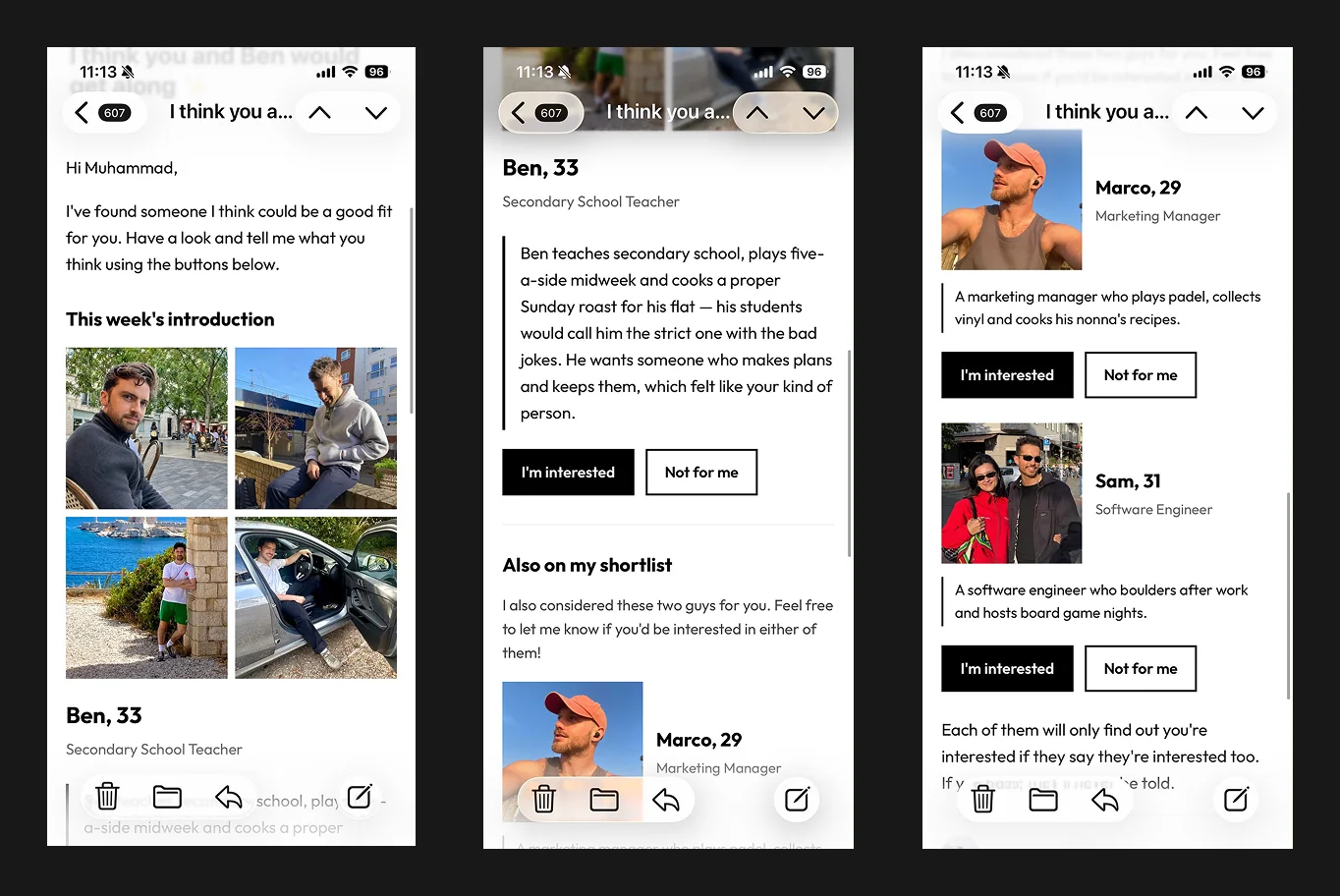
One introduction a week, with the reasoning and the shortlist behind it
AI-powered introductions
- There is no feed. Once a week Scout decides who a member should meet and sends the introduction by email.
- Each one is written for its recipient: what this person is like, and the specific reason the two of them were put together.
- Members reply inside the email, and interest is only revealed when it is mutual.
- Because every candidate is chosen rather than served up, a far higher share of votes turn into real matches.
Making AI quality measurable
- The reasoning in every introduction is generated, so its quality is the product rather than a feature of it.
- I built an evaluation system to measure it: automated checks for factual and formatting failures, an LLM-as-judge scoring the reasoning against a rubric, and a sampled human review to keep the judge honest.
- Every prompt and model change runs against the same set before it ships, so quality is a number I can move rather than a thing I hope for.
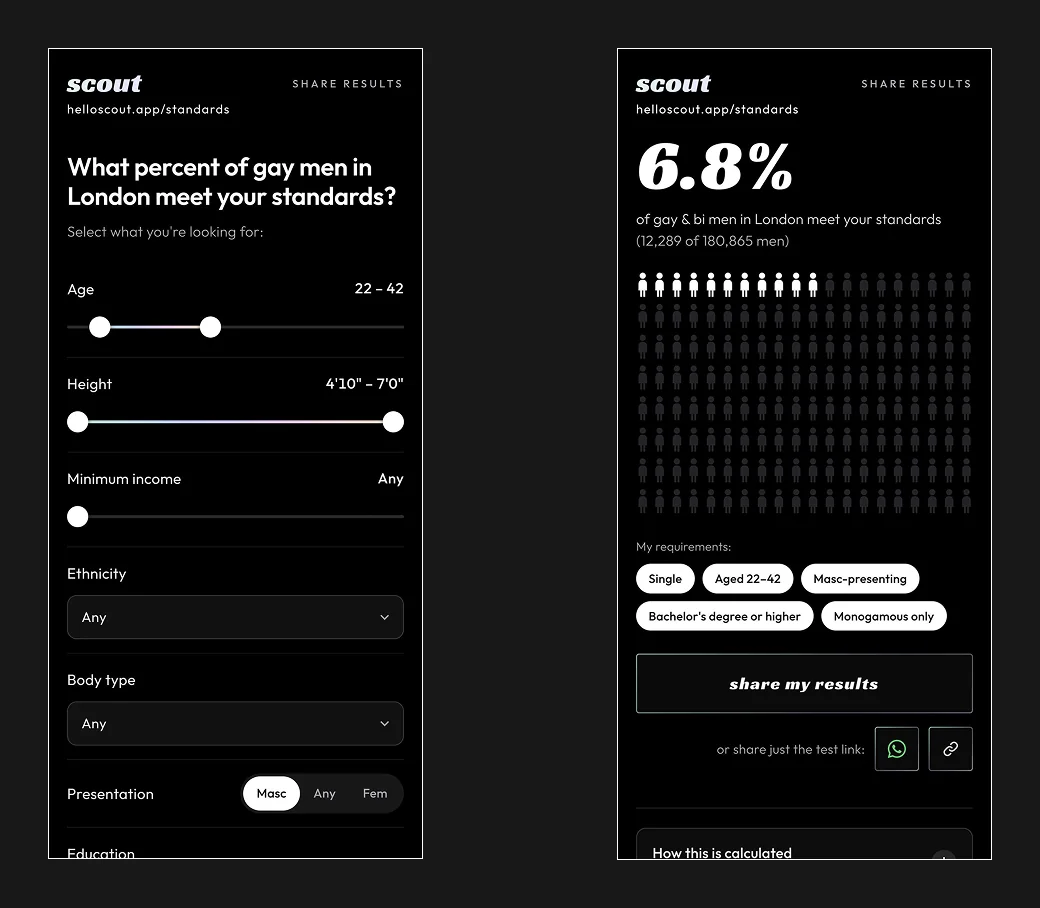
The standards calculator: a shareable result that feeds the core product
Product-led growth
- I built a standards calculator: members pick what they are looking for and it works out what share of the dating pool actually meets it.
- The result is personal and worth sharing, which turns it into an acquisition loop.
- It also argues for the product. A small number is a good reason to let something else do the searching for you.
Outcome
- 800 weekly active users
- 80% W4 retention
- 10× the industry benchmark for matches per vote
- AI-generated match reasoning improved from 35% to 70% passing quality checks